
A Guide to Visiting a Gurdwara

WELCOME TO THE GURDWARA
The gurdwara (‘gate of the Guru’) is the Sikh place of worship (alongside the dharamsala), and its doors are open to everyone, regardless of their religion or background. No one is pressured to change their faith, as Sikhism does not impose its beliefs nor does it consider itself the only path to God. Visitors are simply expected to observe some basic rules whilst inside the gurdwara, the same rules followed by Sikhs.
Clothing
Dress modestly and simply: clothing must cover the shoulders and knees, and must not be too tight-fitting or see-through (no shorts or ripped trousers, short skirts, low-cut tops or sleeveless garments); it should be loose-fitting and comfortable enough to sit on the floor. Unless for medical reasons, it is best not to wear sunglasses indoors; it is also not permitted to wear offensive prints that promote other religions or the use of intoxicating substances, as for obvious reasons such things are also inappropriate for this sacred place. For the sake of simplicity, many also prefer to avoid wearing ostentatious jewellery, as the gurdwara is a place based on equality; however, this is not a strict rule.
Everyone must cover their head. Any clean, presentable scarf or piece of cloth, a dupatta (a long women’s scarf) or a turban will do; there are always scarves available at the entrance for visitors to cover their heads during their visit. Caps, hats and hoods are not permitted as head coverings.
Before entering
Make sure you are clean and tidy. Once inside the gurdwara, take off all your footwear (including your socks) and leave your shoes on the shelves provided for this purpose at the entrance. Then, wash your hands and feet in the designated area as a gesture of cleanliness and respect before entering.
You must not enter whilst under the influence of alcohol or drugs, nor bring in tobacco (or any other drugs or intoxicating substances), alcohol, e-cigarettes or weapons (except for the kirpan or other shastars carried by some Sikhs).
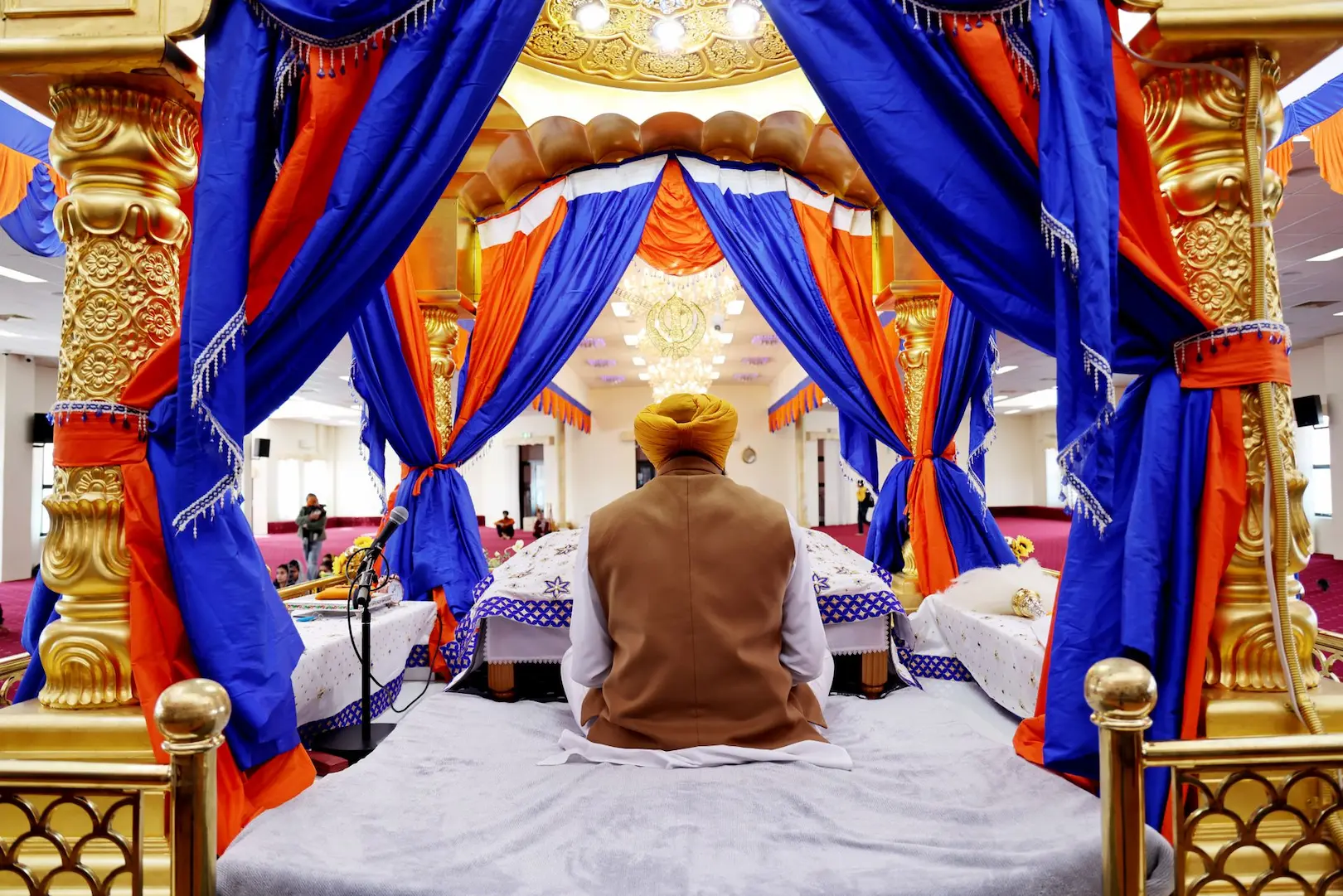
In the hall where the Guru Granth Sahib is enshrined (Darbar Sahib)
Upon entering the hall, the faithful approach the Guru Granth Sahib respectfully and perform the prostration known as ‘Matha Tek’ (touching the forehead), bowing until their forehead touches the floor. This gesture is in no way a form of idolatry: in Sikhism, the Guru Granth Sahib is the living Guru because it is the revealed divine word (Shabad), compiled from the Gurus and various saints. By bowing, the Sikh humbly submits to that divine word and knowledge; worship, however, is reserved solely and exclusively for God. A visitor who is not a Sikh is not obliged to bow: they may enter respectfully or, if they wish, make a slight bow with their hands pressed together. If they wish, they may leave an offering (money, flowers, vegetarian food ingredients for making langar, or even a few words of thanks); this is always voluntary and serves to support the gurdwara and the langar, not as payment, but as a gesture of sharing.
Sit on the floor and never point your feet towards the Guru Granth Sahib, turn your back on the Guru Granth Sahib, or sit higher than the Guru Granth Sahib, as these are considered offences against the Guru. It is also disrespectful to chew gum in this room, speak loudly, gossip, argue or say anything contrary to the Guru’s teachings. Try to remain silent (you may meditate, pray or follow the kirtan), and keep your mobile phone on silent mode.
Karah prashad and langar
During the service, karah prashad is distributed (a blessed sweet made from flour, ghee and sugar). It is sanctified by the Gurbani that has been recited and the Ardas offered over it. It is received with both hands cupped together and distributed equally to everyone.
Langar is the communal, free meal that the gurdwara offers to everyone equally, with people sitting on the floor on the same level, regardless of religion or social class. The meal is always vegetarian or lacto-vegetarian, so that anyone can share in it. You must eat with your head covered, take only what you are going to eat (so as not to waste anything) and, if you wish, you can contribute by making a donation or helping out (sewa).
Volunteering: sewa
Sewa is the voluntary and selfless service that is also done to sustains the gurdwara, and it is one of the fundamental practices of Sikhism: helping in the langar kitchen, serving food to those attending, washing up, tidying visitors’ shoes or cleaning. It is open to anyone, including non-Sikh visitors, and is regarded as a form of devotion and humility.
No formalities or registration are required: simply approach any volunteer (sewadar) and offer your help, or ask the gurdwara manager, and they will tell you where you can lend a hand. Nobody is obliged to take part, but anyone who wishes to do so is always welcome.
The gurdwara welcomes everyone with open arms. All you need to do is enter with respect and humility.