
Sikhism
‘Everything is beneath Truth, but above it stands truthful living’.Sri Guru Granth Sahib – Ang 62
What is Sikhism?
Sikhism, sometimes also referred to as ‘Sikhi’, is a universal (for all humanity) and monotheistic spiritual path established by Guru Nanak in the 15th century in what is now India, which proclaims the equality of all human beings and advocates an ethical, honourable life dedicated to service to others, promoting an active role in society and rejecting asceticism and empty ritualism. Sikhism is one of the spiritual paths with the largest number of followers in the world, ranking fifth globally among religions.
The term ‘Sikh’ is the English adaptation of the Punjabi term ‘Sikh’, which simply means ‘learner’; this is because Sikhism emphasises humility and a constant commitment to learning, growing and improving spiritually.
All human beings, regardless of nationality, race, gender, social class or the religion into which they were born, can be Sikhs; indeed, the formal and orthodox definition of a Sikh is set out as follows:
‘Any human being who faithfully believes in:
– One Inmortal Being.
– Ten Gurus, from Guru Nanak Dev to Guru Gobind Singh.
– The Guru Granth Sahib.
– The utterrances and teachings of the ten Gurus.
– The iniciation bequeathed by the tenth Guru.
and does not owe allegiance to any other religion, is a Sikh’.
(Sikh Rehat Maryada)
What does Sikhism teach?
Some of the core tenets of Sikhism are:
One Supreme God, the creator and supreme ruler of the universe (who has no rival), harbouring no hatred or enmity towards anyone. God has no form or gender (is neither male nor female), and is present throughout all creation whilst at the same time transcending it (is also beyond creation). God does not descend to incarnate in the world; God is always and forever unborn and immortal.
There are various valid spiritual paths to God; there is not just one. I reject the idea that God’s salvation and blessing can only be obtained through a specific religion or spiritual path.
Equality amongst all human beings; no one is superior, no one is inferior. A categorical rejection of the caste system.
The doctrine of reincarnation. The soul has no gender (it is neither male nor female) nor is it confined to a single permanent physical form; it continues to reincarnate in the cycle of birth and death for as long as it remains dominated by the ego and attachment. This cycle continues until the ego is dissolved and one is in complete union with God.
Liberation does not depend on external rituals or on belonging to any particular religion, but on inner transformation through remembering God, living a righteous life and attaining His grace, since ultimate realisation is not merely the result of human effort. The truth must be lived; it is not enough merely to proclaim it.
Rejection to the practice of image-worship or idolatry, asceticism, empty rituals and superstitions.
FUNDAMENTALS OF THE SIKH WAY OF LIFE
The Three Pillars of Sikhism
Sikhism teaches a way of life that is consistent with its doctrine; for if the fundamental principles of Sikh life are not put into practice, mere spiritual knowledge does not lead to liberation. Sikhism rejects asceticism and withdrawal from public life or the world, and promotes an active life committed to society, valuing honesty, compassion and selfless service to others. The Three Pillars of Sikhism were established by Guru Nanak, and are as follows:
Remembering the Name of God (Naam Japna)
Naam Japna means to remember the Name of God and to keep one’s mind focused on Him. In Sikhism, this practice occupies a central place in spiritual life, because it constantly reminds human beings that God is present at all times and in all places. It is not merely a matter of repeating words or performing devotional acts, but of cultivating a constant awareness of the divine presence.
This remembrance of the Name must be a constant feature of a Sikh’s life. Whether working, spending time with their family or participating in society, Sikhs strive to keep their minds connected to God. In this way, spirituality is not separate from daily life, but rather guides their thoughts, words and actions.
Earning an honest living (Kirat Karni)
Kirat Karni means earning a living honestly. In Sikhism, this principle teaches that every person should support themselves through their own efforts and avoid gaining benefits at the expense of exploiting others, through deception or injustice. Work is not regarded merely as a material necessity, but also as a way of living with dignity and responsibility within society.
This principle serves as a reminder that spiritual life is not separate from everyday life. For a Sikh, working honestly is an important part of spiritual practice. Fulfilling one’s work responsibilities, acting with integrity and respecting others in the workplace are all part of a life lived in accordance with the teachings of Sikhism.
Sharing with others (Vand Chhakna)
Vand Chhakna means sharing what one has with others. In Sikhism, this principle teaches that wealth, time and resources should not be kept solely for one’s own benefit, but should also be used to help others. Sharing is part of a just and compassionate life, and serves as a reminder that all human beings are part of the same humanity.
This principle is practised in many ways in everyday life. It can be expressed by helping those in need, supporting the community or devoting time to selfless service. In the Sikh tradition, a visible expression of this spirit is the langar, the communal meal offered free of charge in gurdwaras to anyone, regardless of their background, religion or social status.
Vand Chhakna also involves sharing a portion of what one has earned through one’s own labour, generally 10 per cent of one’s salary, which can be donated to a worthy and just cause, to someone in need, or to a gurdwara. In this way, Sikhism encourages people to live with generosity and responsibility towards others. By sharing with others, a person learns to overcome ego and to build a fairer society, based on equality, solidarity and mutual respect.
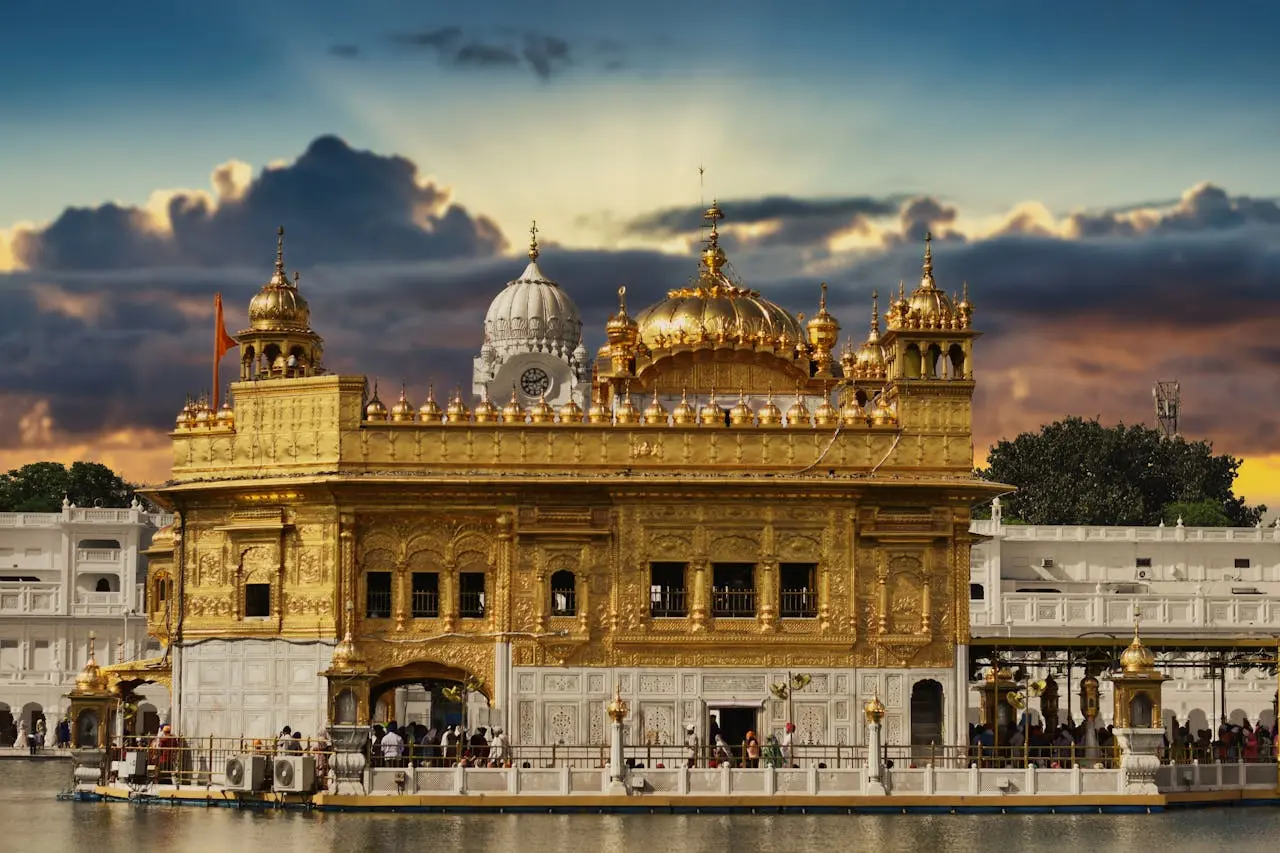
The Gurdwara
THE SIKH TEMPLE
Gurdwara means ‘the gateway to the Guru’, and is the main place of gathering and prayer for the Sikh community wherever one exists. It is a space open to everyone, regardless of religion, origin or social status. At the centre of the gurdwara lies the Guru Granth Sahib, the holy book of Sikhism, which is regarded as the eternal Guru and spiritual guide of the Sikhs. It is compulsory for everyone entering the gurdwara to remove their shoes and cover their heads as a sign of respect for the Guru.
The gurdwara is where the Guru Granth Sahib is recited and explained, where sacred hymns (kirtan) are sung, and where Sikh religious ceremonies are held; it is also an ideal place for prayer and meditation.
A fundamental part of life at the gurdwara is the langar, the communal kitchen where free vegetarian meals are served to all visitors who wish to eat. Sitting together on an equal footing and sharing the same meal symbolises one of the central principles of Sikhism: equality amongst all people.
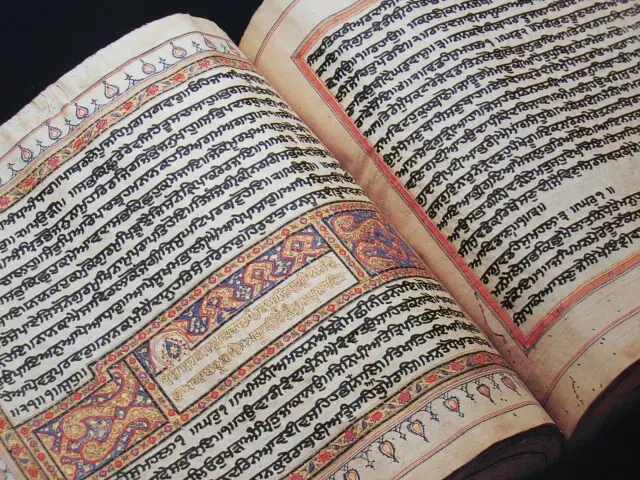
Guru Granth Sahib
THE CENTRAL SCRIPTURE AND PERPETUAL GURU OF SIKHISM
The Guru Granth Sahib is the most important sacred scripture of Sikhism and is recognised by Sikhs as the living and perpetual Guru; for this reason, the Guru Granth Sahib is not regarded merely as a sacred scripture, but as the Guru who provides spiritual guidance to Sikhs.
The Guru Granth Sahib is a collection of spiritual hymns composed by some of the Gurus of Sikhism and by various saints from different spiritual and religious traditions. His teachings centre on devotion to one God, humility, equality amongst all human beings, and the importance of living an honest and spiritual life.
Although the hymns of the Guru Granth Sahib were composed in different languages and poetic forms, thus reflecting its universal spirit, the entire text is written uniformly in the Gurmukhi script. The Guru Granth Sahib always is in a single volume written in the Gurmukhi script, with the hymns preserved intact as they were transmitted and compiled by the Gurus; consequently, any translation of the Guru Granth Sahib, or His division into several volumes, is not considered to be the Guru Granth Sahib (saroop) as such, but rather a translation or edition of the Guru Granth Sahib, and as such, they do not have the same status or treatment.

The Ten Gurus
ONE AND THE SAME LIGHT IN FAITH AND JUSTICE
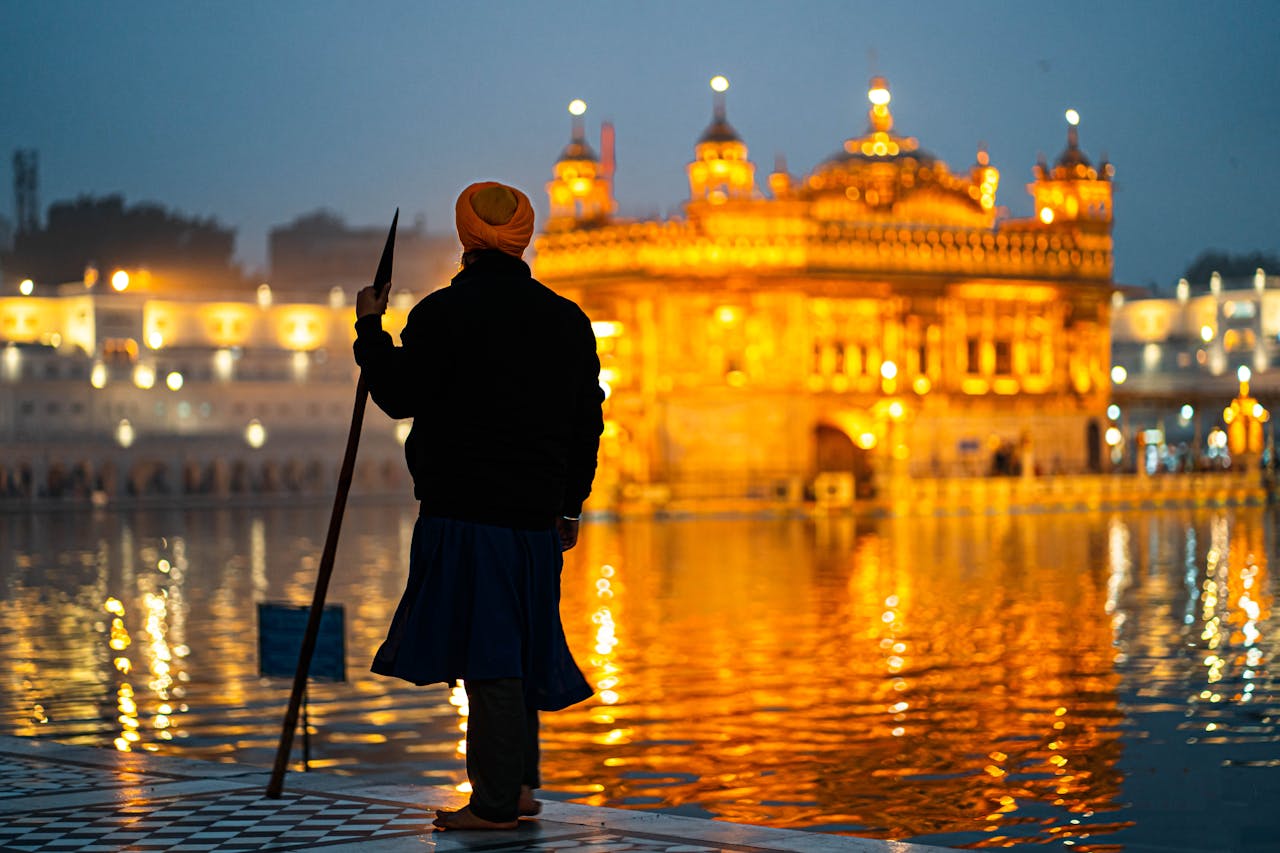
The Khalsa
THE ORDER OF THE SAINT-WARRIOR IDEAL
The Khalsa, which means ‘the community of the pure’, is the community of Sikhs who have been initiated into this order and who must follow, with daily discipline, the path laid down by the Gurus. It was founded in 1699 by Guru Gobind Singh with the aim of forming a community committed to faith, justice and the defence of the oppressed. Since then, the Khalsa has embodied the ideal of living with spiritual courage, discipline and devotion to God.
Those who form part of the Khalsa receive the Amrit initiation and commit to following a formal code of Sikh conduct and discipline. Among their distinctive features are the Five Ks, five essential external symbols that serve as reminders of their commitment to the Sikh faith and identity. They also make members of the Khalsa easily recognizable, enabling those in need of protection to identify them and turn to them for help: kesh (uncut hair), kangha (wooden comb), kara (steel bracelet), kachera (traditional undergarment) and kirpan (a dagger or curved sword symbolising the defence of justice, used only to protect oneself or others).
The Khalsa is not merely an outward identity, but also a spiritual ideal based on discipline, honesty and service to others.
THE FUNDAMENTAL CREED OF SIKHISM
The Mool Mantar
The Mool Mantar literally means ‘The Root Mantra’. It is the founding statement of Sikhism and the opening words of the Guru Granth Sahib, thus forming the foundations upon which the entire Sikh theology is built.
In just a few lines, the Mool Mantar answers the most profound question a human being can ask: what is the Supreme Reality? And it does so with absolute certainty: it is One, Eternal, and nothing exists apart from It.
For Sikhs, reciting the Mool Mantar is not a mere intellectual act but an inner experience. Each conscious repetition brings the practitioner closer to the Real. That is why it forms part of the daily pre-dawn prayer; it can accompany one’s day as a constant reminder; and it is present at the most significant moments of Sikh life, from birth to death.
Below is the Mool Mantar in its original language, along with an orthodox translation of its meaning into English. It should be noted that no translation can convey the meaning of the original words with complete accuracy:
God is One, pervading all,
Truth is God’s name,
The Doer Being,
Free from fear and enmity,
Timeless Reality,
Unborn, Self-existent,
Known by the Guru’s grace.
CLARIFICATIONS ON SIKHISM IN PRACTICE
Frequently asked questions about Sikhism
In this section, we address some of the most frequently asked questions about Sikhism in practice, whilst also clarifying certain issues that often cause confusion regarding Sikhism and its teachings.
Is Sikhism an ethnic or universal spiritual path?
From its very beginnings, Sikhism has been a universal spiritual path open to all humanity, regardless of race, culture, nationality or gender. However, to this day, the vast majority of Sikhs are of Punjabi origin (almost all hailing from what is now the Indian Punjab or descended from those families), which is why the Punjabi cultural influence is very strong. Consequently, there are practices and beliefs widespread amongst many Punjabi Sikhs that are purely cultural or ethnic in nature, but which are often mistaken for or perceived as part of Sikhism when in fact they are not.
Furthermore, at present, almost all Sikh artistic expressions and music are in Punjabi, as the majority of Sikhs today are of this origin. This situation may change as people from other cultures and nations come to Sikhism and adopt it sincerely, living fully as Sikhs whilst drawing on their own cultural backgrounds; for Sikhism in no way requires one to renounce one’s own culture in order to practise and live the faith fully, but only to abandon those specific practices that contradict Sikh principles and doctrine.
From Sikhism For All, we are already working selflessly to create resources on Sikhism for English speakers, and we fully support anyone who joins this cause in accordance with the Gurus’ teachings.
Is it compulsory to wear a turban and let your hair grow without cutting it to be a Sikh?
The definition of a Sikh is based on faith in the Ten human Gurus, in the Guru Granth Sahib as the eternal Guru, and in their teachings. Consequently, within Sikhism there are different levels of discipline adopted by those who identify as Sikhs.
Sahajdharis (also known as Sehajdharis) are Sikhs who are in the process of gradually adopting Sikh discipline (a process which has no fixed timeframe and is an individual journey), as they have not yet fully adopted all the external disciplines. During this process, many have already adopted visible practices such as wearing the turban and the kara (metal bracelet), whilst others have not yet done so.
Keshdharis are those who already keep their hair uncut (kesh) as part of their discipline. If they ever intentionally cut it, they are regarded as sahajdharis.
Finally, the Sikhs of the Khalsa are those who have received initiation and live by the full discipline established by Sikh tradition. The latter have made a formal commitment to uphold the full rigour of Sikh discipline.
At the same time, the Sikh Rehat Maryada (the Sikh code of discipline and conduct) stipulates, as part of Sikh discipline, that one must keep one’s hair uncut (kesh) and, in the case of men, wear a turban as the traditional way of covering and presenting it; for women, this is optional (although some schools require it of both genders).
Therefore, a person may be considered a Sikh and begin to follow the Sikh way of life without having yet adopted all of these practices. However, these form part of the Sikh ideal and traditional discipline, and their adoption is seen as part of a process of commitment to the Sikh tradition.
Do I have to know or learn Punjabi to be a Sikh?
No, it is by no means necessary for a Sikh who is not Punjabi to learn the Punjabi language. There are Sikhs in various parts of the world, some from long-established communities whose language is not Punjabi; consequently, they either do not know it or have only a limited knowledge of it.
It is essential to learn to recite the Mool Mantar in its original language, which was recited in Punjabi. It is short and simple, but it is not necessary to learn the language in order to live as a Sikh. It is also encouraged to learn to read the Gurmukhi script so that one can read the text of the Guru Granth Sahib in His original form; however, this is by no means the same as learning a language, and it can be achieved in a relatively short time.
There are translations of the Guru Granth Sahib into various languages, and there are an increasing number of authentic online resources in different languages that help people to learn about Sikhism as it truly is.
Do all the beliefs and practices of Punjabi Sikhs belong to Sikhism?
The answer is a resounding no. The Punjabi people have a distinct social culture, just like any other people in the world, and that culture is absorbed by Punjabis from childhood, meaning that Punjabi Sikhs (the majority of Sikhs to this day) learn it intermingled with Sikhism, sometimes without being able to distinguish between what is cultural and what actually belongs to Sikhism.
It is also worth noting that certain specific practices and beliefs followed by many Punjabi Sikhs are in fact the persistence of Hindu elements within Sikh practice, a result of the enormous Hindu cultural influence in India. Some of these beliefs and practices are even contrary to Sikh principles and doctrine.
What should I do if there isn’t a gurdwara near where I live?
The gurdwara plays a very important role in the lives of Sikhs, although the reality is that outside India there are many places where they are few and far between or do not exist at all. Therefore, where there are none, a Sikh can live without attending a gurdwara and may even set up a dharamsala (physical or online), which is a place of spiritual gathering established by Guru Nanak and the early Gurus of Sikhism so that the faithful may come together as a community to learn the spiritual teachings of Sikhism, and even to welcome pilgrims or organise langar, the Sikh communal meal. The dharamsala is the precursor to the gurdwara and may be established by any devout Sikh of good will who respects and does not contradict the teachings of the Guru Granth Sahib or orthodox Sikh tradition, regardless of whether or not they know the Punjabi language or of their nationality or ethnicity.
From Sikhism for All, we firmly support and encourage the establishment of dharamsalas throughout the world as a means of keeping Sikh spiritual and community practice alive in places where there are no gurdwaras.
What is the name of God in Sikhism?
In Sikhism, the Supreme Reality does not have a single proper name, and, being infinite, cannot strictly be contained within a single word. For this reason, the Guru Granth Sahib refers to God by many different names, drawn from various religious traditions, such as: Hari, Ram and Gopal from Hinduism; Allah, Khuda and Rabb from the Islamic tradition; alongside others adopted and established by Sikhism such as Satnam (True Name), Nirankar (Formless) or Ek Onkar (The Supreme Reality is One).
The Gurus of Sikhism taught that there are many names that point to the same Supreme Reality, though none can fully encompass it. However, in Sikh devotional practice, the name most commonly used to refer to and address God is Waheguru, which can be translated as ‘Marvellous Dispeller of Darkness’.
Waheguru is regarded as the Gurmantra, the principal mantra bestowed by the Guru for constant recitation and meditation on God.
Thus, Sikhism does not impose a single name for God, but recognises that all humanity invokes, in their various languages and traditions, the one and same Supreme Reality.
What is the kirpan (a religious bladed weapon), and why do Sikhs carry it?
It should first be clarified that not all Sikhs carry a kirpan: it is only compulsory for Sikhs initiated into the Khalsa (Amritdhari), who have undergone the Amrit Sanchar ceremony and have committed themselves for life to its code of conduct. This obligation applies equally to both men and women. Sikhs who have not been initiated into the Khalsa (who make up the majority) are not obliged to carry it and do not usually do so, although they may choose to do so voluntarily.
The kirpan is one of the Five Ks (Panj Kakar), the five articles of faith instituted by Guru Gobind Singh in 1699 when he founded the Khalsa. Its name combines the concepts of kirpa (grace, compassion) and aan (honour, dignity), and embodies the ideal of the Sant-Sipahi (holy warrior): the duty to cultivate spiritual life whilst, at the same time, upholding justice and protecting the oppressed. It is not a weapon of aggression, but a sacred symbol of restraint, dignity and compassion. Sikh doctrine permits its use only in self-defence or in defence of others against unjust and proportionate aggression, and never to attack, intimidate or impose oneself on anyone.
As for its shape, it is a curved, single-edged blade, derived from the talwar (the traditional Indian curved sword). The Sikh code of conduct does not prescribe a specific size: traditionally it was a full-sized sword (around 76 cm), which was reduced in size during the British colonial period, and today it is usually a dagger measuring between 12 and 30 cm (although much larger kirpans are still carried in the Punjab). There are two schools of thought regarding size: the more practical one, common in the West, accepts very small kirpans (measuring just a few centimetres) for legal and discretionary reasons. The more orthodox view holds that, however small it may be, it must remain a functional object and not merely a symbol.
It is made of steel or iron (not luxurious materials) and is carried sheathed, secured to the body by the gatra, a strap that crosses over the shoulder, usually under one’s clothes.
Where the carrying of the kirpan is regulated by national law, the Sikh community has always sought dialogue and accommodation within the legal framework.
What is the Sikh stance on homosexuality?
The Guru Granth Sahib makes no mention of homosexuality, and no such inclination in itself condemns anyone. Five vices beset the human mind when it is not united with God (lust, anger, greed, worldly attachment and pride), and the spiritual life consists precisely in not allowing oneself to be swept away by them. What each person brings with them at birth stems from their actions in previous lives and from the Divine Will: it is not a punishment, but rather the conditions under which each person must walk their path. And in Sikhism, no one is determined by that past, because Divine Grace stands above it: liberation is neither gained nor lost through the circumstances into which one is born, but is attained through that Grace.
One is held accountable for whatever one yields to and nurtures within oneself, whether in thought, word or deed. That is why a person with a homosexual inclination can also attain sainthood in that very same incarnation, just like anyone else: and this is not achieved simply by observing an external discipline, which in itself saves no one, but by remembering God continually and living with one’s heart turned towards Him. And for that very reason, no one should be singled out or mistreated for what they feel: to do so goes against the Guru’s teaching.
When it comes to behaviour, the situation is different, and here there is a single rule that applies equally to everyone: sexual relations belong within the sphere of marriage, and in Sikh doctrine, marriage is the union of a man and a woman, regardless of the legal form in which it is celebrated. This is laid down in the Sikh Rehat Maryada, the orthodox Sikh code of conduct, which describes the Anand Karaj (the Sikh marriage proper) solely as the union of a man and a woman.
The Ten Gurus never officiated at anything other than this, and this has been the understanding within the Sikh community ever since. In 2005, in response to the ongoing debate in Canada, the Akal Takht (the highest institutional authority within Sikhism) was compelled to make a public statement declaring that same-sex marriages were prohibited in any gurdwara worldwide, and it reiterated this position in 2009. It did not establish anything new at that time: it merely publicly reaffirmed what had always been the case, in the face of pressure from contemporary Western moral standards.
Outside marriage, chastity is required of everyone equally: there are no double standards.
A final word of warning. Recently, certain groups and individuals in the West have emerged who present homosexual practice and such unions as fully compatible with the Sikh way of life. They are not, and it is worth stating this plainly: what they are doing is not interpreting Sikh doctrine, but rather adapting it to the prevailing morality of the moment in the West, in order to please and thus win followers.
The price of this manoeuvre is the Guru’s message. Such movements and individuals have at times even gone so far as to deny reincarnation, which is a central tenet of Sikhism (the soul passes through countless forms of life, and liberation consists precisely in breaking free from that cycle of births and deaths), in order to increasingly align themselves with Western materialist philosophy. Anyone who begins by manipulating what is unpopular in a society ends up preaching something else, falsely in the Guru’s name.
Sikhism does not need to be manipulated to please a society’s dominant discourse: it needs to be lived as it is.
Is Sikhism a rigid spiritual path full of prohibitions?
Here it is necessary to draw a distinction between Sikhs who have not taken initiation into the Khalsa and those who have, as the level of discipline expected differs.
For those who have been initiated into the Khalsa, there is a clearly defined code of conduct known as the ‘Sikh Rehat Maryada’ (although certain specific schools have their own codes of discipline). Among other things, this code sets out certain prohibitions designed to ensure a disciplined life consistent with the teachings of the Sikh Gurus. These include a ban on the use of tobacco or other intoxicating substances, the consumption of alcohol, the eating of meat prepared through ritual slaughter (kutha), and cutting one’s hair, as well as the obligation to maintain responsible sexual behaviour within marriage between a man and a woman.
However, Sikhism does not present itself as a path based on a long list of prohibitions. Its teachings emphasise living a righteous and mindful life. In this regard, Sikhism rejects practices such as the caste system, idolatry and superstition, and condemns any form of contempt for human life, such as infanticide and other practices that undermine human dignity. It also encourages the avoidance of exploitation, deceit, corruption and injustice.
Instead, it promotes a way of life based on remembering God (Naam Japna), earning an honest living (Kirat Karni) and sharing with others (Vand Chhakna).
Does Sikhism support the caste system from India?
Absolutely not; Sikhism does not support India’s caste system; in fact, it condemns it.
India’s caste system stems from Hindu traditions, a blend of religions that has been the dominant faith for millennia across much of the Indian subcontinent. This religious hegemony of Hinduism has had an enormous influence on the region’s culture, making it so deeply ingrained that many Muslims and Sikhs in the area practise and support a caste system of their own, even though these two spiritual paths have nothing to do with any caste system.
Guru Gobind Singh, with the aim of counteracting India’s caste system, decreed that Sikh men should adopt the name ‘Singh’ and Sikh women the name ‘Kaur’ after their first names, so that all Sikhs would share a common identity based on equality, thereby eliminating surnames associated with caste distinctions.
What is the symbol that represents the Sikh religion?
The most commonly used symbol to represent Sikhism is the Khanda (☬), which is also the symbol representing the Khalsa. The Khanda consists of a central double-edged sword, symbolising divine truth and justice, surrounded by a circle called the chakkar, which represents eternity and the oneness of God, and by two curved swords called kirpans, which symbolise the balance between spiritual authority and worldly responsibility.
The Khanda also appears on the Sikh flag known as the Nishan Sahib, which is found in gurdwaras. This orange or saffron-coloured flag indicates the presence of a gurdwara and symbolises Sikh identity and community.
Another symbol recognised as belonging to Sikhism is the Ek Onkar ( ੴ ), which is written in Punjabi and means ‘God is One, pervading all’.
Is Sikhism intolerant, or does it condemn followers of other religions?
It could be said that Sikhism is, amongst the major theistic spiritual and religious paths, the most tolerant and inclusive. Whilst other major religions or spiritual paths claim to hold a monopoly on truth and/or salvation, and indeed, some of the major ones even condemn believers of other religions to eternal punishment in their doctrines, Sikhism completely rejects the idea that God has a chosen few or that salvation is available only to those who belong to a single, specific religion.
The teachings of Sikhism proclaim that God helps and blesses all sincere believers, that there are genuine saints in different religions and spiritual paths, and that salvation does not belong to any particular religion or people.